



Pull Production at Zero Cost: Start with the Two-Bin Method
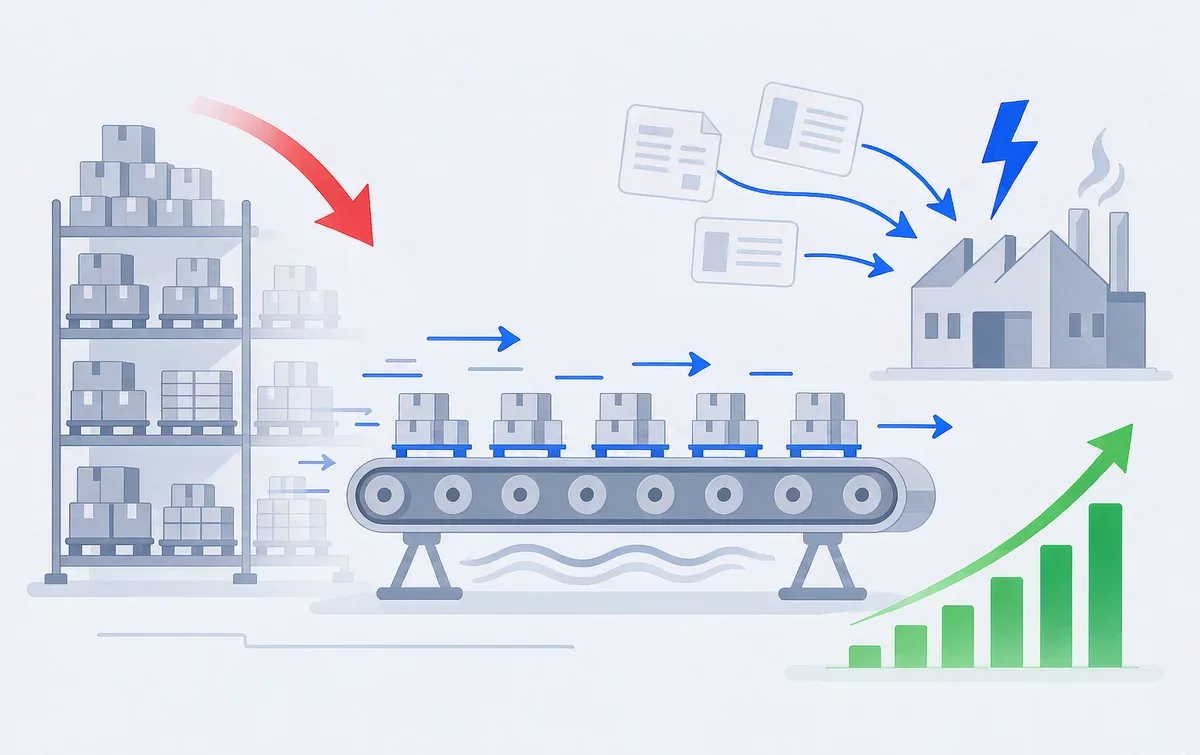
Last week at a hardware factory in Foshan, the owner showed me a warehouse corner: dozens of varieties of screws, washers and small springs, bins stacked on bins, labels in disarray. For a worker, fetching one part routinely meant ten-plus minutes of rummaging.
The owner asked: “Sir Leng, I hold plenty of inventory — why do we still stop the line for missing parts?”
I told him: because your material is “pushed” — the planner sends a big batch to the shop floor at once based on experience; what isn't used piles up at the line, and what is needed can't be found. You have two diseases at once: inventory buildup and stockout stoppages.
The remedy I prescribed is simple: the two-bin method. No system to buy, no WMS to deploy — not even Excel.
1. What Is the Two-Bin Method?
One sentence: each item gets two bins of the same size.
Workers use bin A first; when A empties, it goes to the return zone and bin B is pulled forward. The empty bin is the replenishment signal — the material handler sees an empty bin and knows to refill it. No shouting, no asking, no guessing.
2. It Looks Rustic, but the Ledger Is Real
- Inventory comes down. At most two bins per small item at the line — previously a mountain, now just two totes. For C-class items like screws and washers, inventory value drops by a large chunk;
- Space is freed. No more mixed piles at the line: wider aisles, less transport, a cleaner site;
- Fewer stockout stoppages. An electronics plant applied two-bin kanban to high-frequency small parts like 0402 resistors and capacitors; monthly average stockout downtime fell from 3 hours to zero;
- No system needed. Two bins, one label, one fixed route — running before any software could even be installed.
3. How to Land It: Three Steps
- 1. Pilot with small items first. Don't roll out plant-wide on day one. Start with C-class items — low value, stable usage, many varieties: screws, washers, labels, R/C components. They are the easiest to mess up and the quickest to show results;
- 2. Calculate bin size. Bin capacity = consumption within the replenishment cycle + a little safety stock. If the supplier delivers every two days and you use 100 per day, load about 250 per bin. Too large defeats the purpose; too small risks shortages;
- 3. Fix location, route and owner. Bins sit at fixed positions at the workstation; the return zone is fixed too. The handler patrols a fixed route at fixed times and refills on sight of an empty bin. Not by workers phoning in, not by the warehouse remembering.
One remark that may offend: many plants haven't even gotten the two-bin method running smoothly before wanting line-side warehouse systems and WMS — that's outsourcing your fundamentals to software. The core of pull production is not how advanced the system is, but how simple the signal is and how fast the response. If two bins can solve it, don't rush to spend hundreds of thousands on an answer. Simplify the pull signal first — nothing beats it.
Reposted from the Toutiao account 「精益智造践行者」 (Lean & Smart Manufacturing Practitioner).
Original article: https://www.toutiao.com/article/7678276894580310571/
Yanjia Digital Technology (Shenzhen) Co., Ltd.
Lean Foundation · Intelligent Future
© 2026 Yanjia Digital Technology (Shenzhen) Co., Ltd.Core Business
Contact
- Tel: 173-2232-9880 (WeChat)
- Email: Jason.leng@szyanjia.com
- Address: Lankun Building 712, Minkang Rd., Longhua District, Shenzhen
Scan & Follow


Assessment


