



Smart Factory Planning: Choose the “Powertrain” Before You Build
Over years of lean consulting and smart factory planning, I have seen far too many regrettable failures.
The renderings get prettier and prettier: tall workshops, gleaming epoxy floors, brand-new imported equipment, futuristic visualized sites. Yet after construction ends and a year into production, the owner frowns deeper than before the move: capacity won't climb, costs won't come down, lead times keep stretching. A beautiful shell with the wrong engine installed.
1. The Problem Starts at Step One: Skipping “Production Mode Design”
Where does it go wrong? Not in the drawings, not in the equipment, but in the very first step. Most people start factory planning thinking “what goes on floor one, where the warehouse sits, and we need a nice showroom”, then immediately hire a design institute, ask suppliers for proposals and equipment quotes — skipping the one thing that should come first: designing the production mode.
2. What Is Production Mode? It Is the Factory's “Powertrain”
Here is the analogy: the production mode is to a factory what the powertrain is to a car.
Gas, electric, or hybrid? That must be decided before you build the car. The powertrain determines chassis layout, body design, and where the fuel tank or battery goes. If you build a gas car and then want the quietness and savings of an EV, do you swap the engine for a battery? That is not a retrofit — that is building a new car.
Factories are identical. Choose high-volume assembly lines and the plant must be laid out for straight-through material flow; choose lean mixed-model cells (CELL) and lines must cluster by process similarity; choose flexible automation and column spans, floor loads, and power capacity must be embedded in the civil works. The mode defines the factory's skeleton, and the skeleton is poured in concrete once — changing it later means touching load-bearing columns, fire systems, and electrical distribution: open-heart surgery.
3. The Price of a Wrong Mode: Four Ledgers
Once the mode is wrong or mismatched with the business, four ledgers go red.
First, capacity. Orders are growing, yet output is stuck at a bottleneck. Every machine looks underutilized alone, but total output refuses to rise.
Second, cost. I have seen a company whose order mix had long shifted to “multi-product, small-batch”, while the lines were still designed for high-volume sequential production: ten-plus changeovers a day at thirty minutes each, four to five hours lost daily; work-in-progress piling across the shop floor because it could not be stored in time. Meanwhile a leading powertrain maker in Shandong, through mode redesign plus an AI-driven agile manufacturing system, compressed complex changeovers from five or six hours to near-seconds — that is the gap between mode and equipment working together. And note: physical limitations created by a wrong mode cannot be fixed by any AI.
Third, efficiency. Automated islands each shine while end-to-end flow is full of breakpoints: machines waiting for material, people waiting for machines, managers waiting for data. Efficiency drains into transport, waiting, and data alignment — the opposite of lean “flow”.
Fourth, lead time. An outdated mode cannot flex with order structures and process changes: scheduling by experience, material by chasing, excess WIP making every search slow. Delivery stretches, managers become firefighters, and higher-level planning becomes impossible.
None of these four ledgers can be fixed by “adjusting the layout” or “buying software” — the root cause is the mode.
4. Which “Powertrain” Fits Your Business?
Before choosing, answer three questions: What is your order structure? How long is the product life cycle? What is the growth path for the next five years?
- Few products, high volume, stable demand — the “gas car”: high-volume lines where scale is the competitive edge;
- Fast iteration, tight precision, high data value — the “electric car”: flexible automated lines trading automation and data for speed;
- Many products, volatile orders, careful budgets — the “hybrid”: lean mixed-model cells, one line serving multiple series, lean as the base with targeted automation;
- Or a layered combination: some products on high-volume lines, some on flexible lines, small custom orders on CELL lines — tailored to your situation.
There is no best mode, only the best-fitting mode. Zoomlion's shared-manufacturing smart plant runs 70+ excavator models in mixed flow with over 90% steel utilization and 70% lower WIP — a factory reverse-engineered from the “shared manufacturing” mode, not a plant built first and thought about later. Someone else's “electric car” may stall in your yard.
5. The Correct Planning Sequence: Soul Before Skin
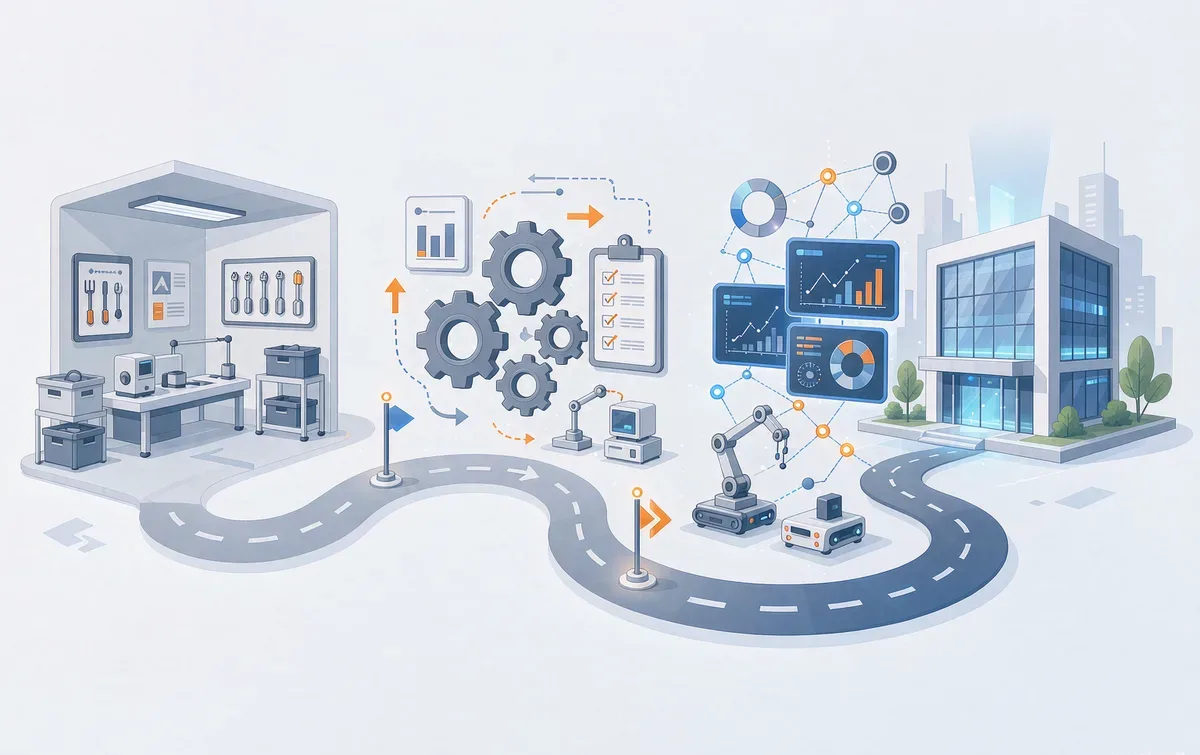
The correct sequence is four progressive layers: business mode → production management mode → process flow and intelligent logistics → building layout and equipment.
Mode design is not guesswork: order analysis, product-family classification, capacity simulation, process-affinity analysis, SLP layout design and logistics simulation — no step can be skipped. That is why professional planning services spend far more effort on the “invisible” mode design than on drawings.
Remember: choose the powertrain before building the body; define the mode before laying out the plant. A smart factory is about substance — comprehensive gains in efficiency, cost, quality, and lead time — not a prettier shell. For most owners a new plant is the largest investment of a lifetime; spend the first effort on the “invisible”, because that decides the factory's fate for the next decade.
Reposted from the Toutiao account 「精益智造践行者」 (Lean & Smart Manufacturing Practitioner).
Original article: https://www.toutiao.com/article/7702360082335547940/
Yanjia Digital Technology (Shenzhen) Co., Ltd.
Lean Foundation · Intelligent Future
© 2026 Yanjia Digital Technology (Shenzhen) Co., Ltd.Core Business
Contact
- Tel: 173-2232-9880 (WeChat)
- Email: Jason.leng@szyanjia.com
- Address: Lankun Building 712, Minkang Rd., Longhua District, Shenzhen
Scan & Follow


Assessment


