


Five Costly Mistakes to Avoid in Smart Factory Planning (with a Self-Check List)
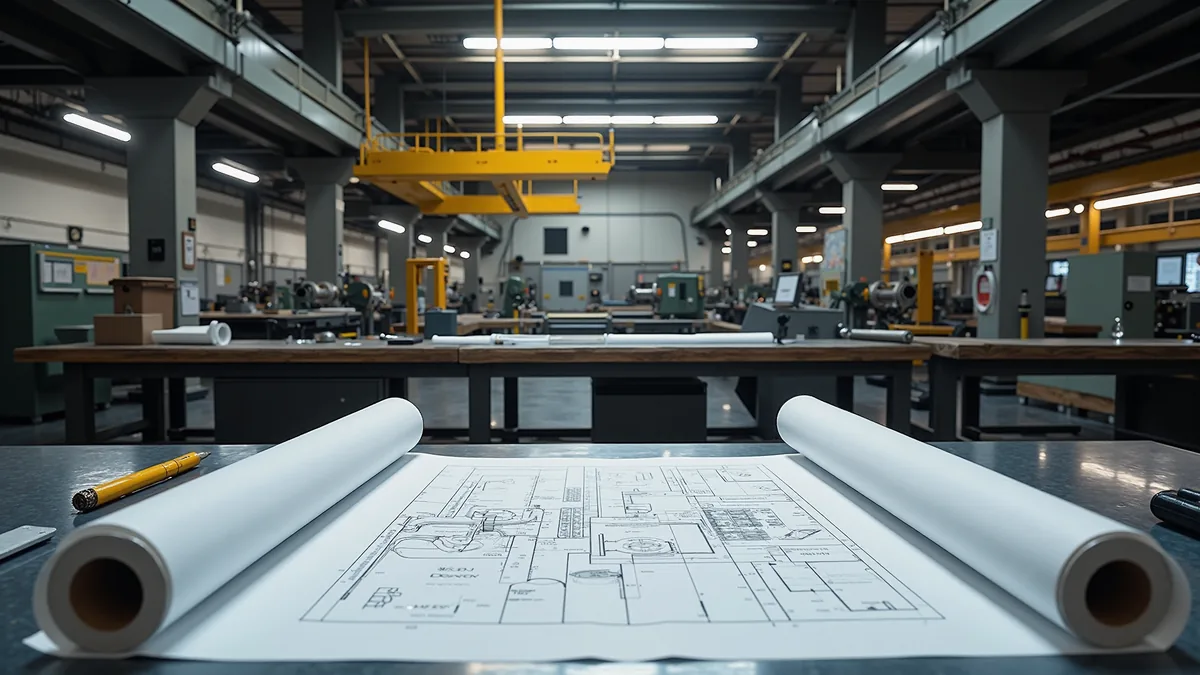
Over the past few years we have taken part in dozens of smart factory and new plant planning projects. What really hurts is rarely a shortage of budget — it is money spent in the wrong place: a workshop built halfway before the process flow turns out not to work, equipment installed on a line before anyone can adjust it, and a system still catching up on basic data two years after go-live.
What these problems share is that they were planted during planning, and only surfaced during construction and operation. The five pitfalls below are the ones we see most often, and the ones that cost the most.
Pitfall 1: Build the building first, fix the process later
The most typical scenario: the land is secured, the owner is eager to break ground, so a design institute is asked to draw a "standard factory" with generic column spacing, clear height and floor loading. By the time the process plan is ready, the equipment will not fit through the door, the lifting height is insufficient, the clean area cannot be partitioned, and the logistics aisle conflicts with the fire escape route.
Once the roof is on, renovation costs multiply by an order of magnitude. Worse, some constraints simply cannot be changed — column grid determines whether a line can run as one continuous flow, and clear height determines whether vertical warehousing is even possible.
The right sequence is the reverse: define product and process route first, then capacity and takt time, then the equipment list and footprint, and only then translate that into building parameters. A building is a container that serves the process, not a container you fill afterwards.
Pitfall 2: Mistaking automation for intelligence
Many projects count "a few robots and a couple of automated lines" as the achievement of a smart factory. But if those machines do not talk to each other, if data never leaves the equipment, and if exceptions are still shouted across the floor, then all you have done is swap manual stations for automated ones. The management level has not moved at all.
Here is a simple test: when a machine stops, does the system know? Can it work out how long it stopped, why, and which orders are affected — automatically? If the answer is no, you are still at the automation stage.
The core of intelligence is not how advanced the equipment is, but whether the loop of sense — decide — act closes on its own. Equipment is only the end effector; the value sits in data capture, rule-based judgement and scheduling decisions in between.
Pitfall 3: Nobody owns master data and material coding
This is the most underrated lesson and the hardest to fix later. Every department keeps its own material codes, every team holds a different BOM version, and process routes live in a veteran operator's notebook. In that state, any system you deploy simply moves the chaos into a computer.
We have seen an electronics plant where the same resistor carried three different codes across purchasing, warehouse and production — and half of the shortage list from MRP turned out to be false. Nothing was wrong with the system; the data was simply unusable.
Three things should be settled during planning: the material coding rule, the BOM hierarchy, and the convention for writing process routes. These are the foundation of digitalisation. Sorting them out before go-live costs at least three times as much.
Pitfall 4: Buy equipment, forget the people
Equipment can be bought with money; people who can run it well cannot. Many plants allocate tens of millions to machinery, a token training budget of a few thousand, or nothing at all for people development.
The result: three months after start-up, OEE is still below half of the design value; the MES is live but supervisors still reconcile against paper sheets; when an alarm fires, everyone waits for the vendor's engineer to fly in.
Planning must answer three questions: what new roles will the plant need? Where will these people come from, and when will they be in place? How will pre-start-up training and multi-skill reserves be arranged? A reliable practice is to have future supervisors and equipment leads take part in installation and commissioning from day one — the commissioning period is the best training ground there is.
Pitfall 5: Count one-off capex, ignore three-year TCO
The equipment quotation shows the purchase price, but the real cost is the three-year total cost of ownership: purchase, installation, energy, consumables, maintenance, spare parts, software subscription, people, and downtime losses.
Some proposals look cheap up front but consume more energy, use expensive spares and get slow maintenance response — the three-year total ends up higher. Others are generously equipped with intelligence, but capacity utilisation and order structure cannot support the investment, leaving the payback period out of sight.
Our advice: every major investment should come with a three-year TCO and payback calculation, read alongside the capacity ramp-up curve. Equipment does not run at full load the day it arrives; ramp-up often takes six months to a year.
Appendix: a 21-point self-check list
The list below is organised in three phases and can be used as-is. You do not need to tick every box — but every unticked box is a place where the project may blow up.
Planning phase (8 items): is the product and process route defined down to operation level? Have capacity targets and takt time been calculated? Is the equipment list and footprint reflected on drawings? Do column grid, clear height, floor loading and cleanliness class match the process? Are logistics routes and WIP buffers planned? Are material coding and BOM rules fixed? Have three-year TCO and payback been calculated? Is the organisation structure and staffing designed in parallel?
Construction phase (7 items): are civil works and equipment arrival aligned on the schedule? Do utilities — power, gas, water, network — carry enough headroom? Are equipment communication protocols and data interfaces unified? Are the responsibility boundaries between system integrator and equipment vendor clearly drawn? Is the installation, commissioning and trial production plan detailed to the week? Are safety and environmental acceptance milestones brought forward? Have key role holders joined commissioning?
Operation phase (6 items): are OEE, first-pass yield and on-time delivery baselined? Is data capture coverage adequate? Is the exception response mechanism closed-loop? Is a spare parts stocking policy in place? Does the multi-skill ratio support flexible production? Is someone accountable for continuous improvement?
Among these 21 items, the three most easily skipped are the last three in the planning phase — coding rules, TCO calculation and organisation design. They are less visible than buildings and machines, yet they decide whether the plant is an asset or a burden three years from now.
One last word
A smart factory is not bought — it is planned. One extra month in planning can save a year in construction and operation.


